The Moon Phase Soulmate Trend: What It Is, How It Works, and Whether It Holds Up
How a Niche Astrology Idea Became a Viral Test
Long before anyone was overlaying moon phases in an editing app, astrologers were already asking a quieter version of this question: does the moon’s phase at the moment of your birth shape who you’re drawn to romantically? Social media just gave that old idea a visual hook — and it spread fast.
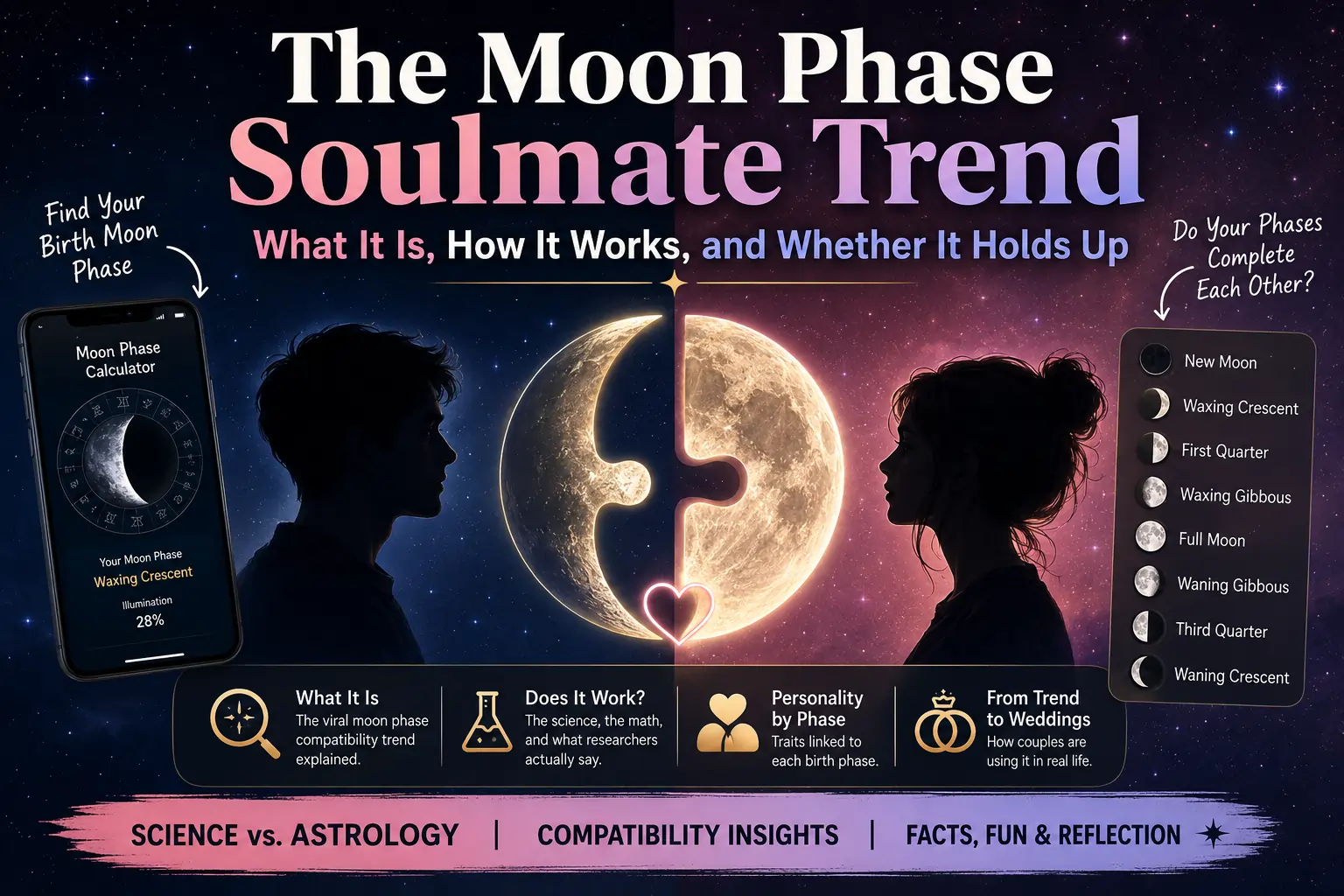
The premise is simple. Your natal moon phase the shape of the moon on the night you were born — supposedly colors your emotional temperament, your communication style, and how you show up in relationships. Line up two people’s birth phases side by side, and if the shapes appear to complete each other into a full moon, believers treat that as a kind of cosmic stamp of approval.
Whether you take it seriously, treat it as harmless fun, or dismiss it outright, the conversation around lunar compatibility hasn’t slowed down — and it’s worth understanding both the appeal and the actual math behind it.
What the Trend Actually Involves
The test itself is straightforward:
- Use a moon phase calculator to find your exact natal moon phase from your birth date.
- Do the same for a partner, friend, or crush.
- Overlay the two lunar images — often using an editing app — to see whether they visually combine into a complete circle.
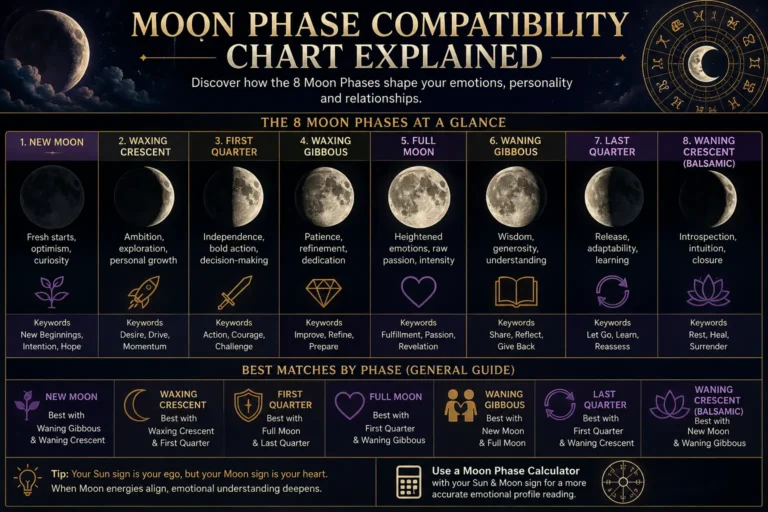
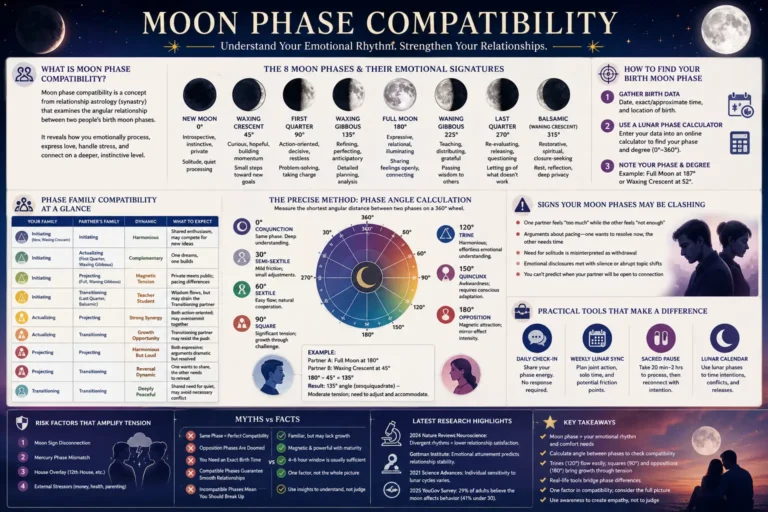
Astrologers who take this seriously argue it’s not just a pretty graphic — each of the eight recognized moon phases is said to carry a distinct emotional signature, and pairing two complementary phases theoretically points to a relationship that can handle real pressure, not just initial attraction.
A New Moon birth phase, for instance, is associated with one relationship style, while a Full Moon birth phase supposedly operates on an entirely different emotional wavelength — which is the reasoning behind why some pairings feel effortless and others feel like a mismatch despite genuine chemistry.
Does the Math Actually Support It?
Here’s where the trend runs into trouble. NASA recognizes eight distinct lunar phases: new moon, waxing crescent, first quarter, waxing gibbous, full moon, waning gibbous, third quarter, and waning crescent.
Do the arithmetic on a global population of roughly 8 billion people spread across only eight categories, and each phase group contains close to a billion people. That means the pool of “compatible” partners under this system is so large it becomes essentially meaningless as a filter — any two people, statistically, were always going to find someone whose phase completes theirs.
There’s genuine science behind how the moon’s illumination cycle works. There’s no peer-reviewed research connecting a person’s birth phase to their romantic compatibility in any way that holds up under scrutiny.
What Astrologers and Researchers Actually Say
Most researchers describe this as a familiar pattern: old astrological framing given a new, algorithm-friendly aesthetic. The core scientific problem is falsifiability — a claim needs to be testable and disprovable to hold scientific weight, and moon-phase-based compatibility has never cleared that bar.
Astrology and astronomy share ancient roots but split apart centuries ago into very different disciplines — one interprets symbolic meaning from celestial positions, the other measures and predicts them with evidence. Even practitioners of serious natal chart work tend to push back on the oversimplification here — Venus, Mars, house placements, and full chart synastry all factor into compatibility far more than a single birth phase ever could.
That said, several astrologers point out the trend’s real value isn’t predictive accuracy — it’s the reflective conversation it opens up. Comparing charts, even loosely, can prompt two people to actually talk about emotional needs and relationship patterns, which has value independent of whether the astrology itself is “true.”
Why This Particular Trend Went So Viral
The hashtag cluster around this concept exploded in 2022 and saw a second wave of momentum in 2023, racking up hundreds of millions of views across short-form video platforms within a short window.
A big driver here is straightforward confirmation bias. Couples whose phases appeared to “match” were far more likely to post their results excitedly; people whose phases didn’t line up mostly just quietly dropped the test without ever sharing it. That imbalance created an online narrative that looks far more validating than the underlying odds actually are.
The appeal isn’t really about accuracy — it’s about the emotional payoff of a visually satisfying result feeling like proof, in an area of life (romance) where people are often hungry for exactly that kind of reassurance.
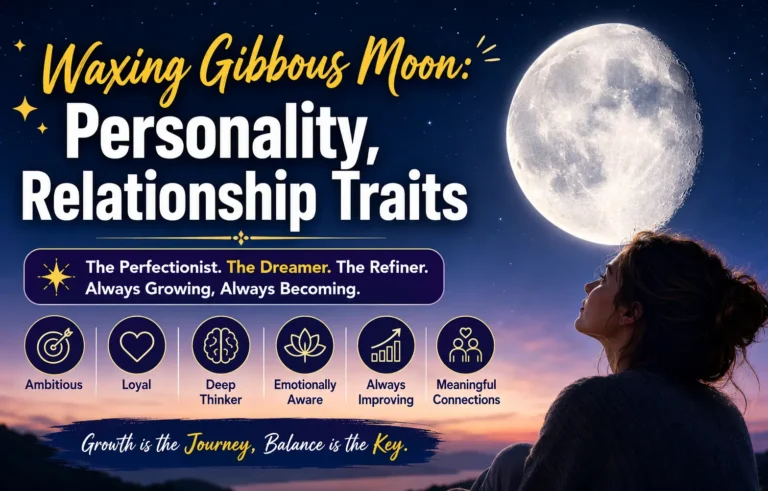
Personality Traits Linked to Each Birth Phase
- New Moon — Drawn to novelty, gets restless with routine fast, wants a partner who matches that hunger for new experiences.
- Waxing Crescent — Craves stability more than most; thrives with a partner who builds consistency rather than constant change.
- Eclipse-adjacent births — Associated with a more unpredictable, intense temperament; pairs best with someone grounded enough to find that energy exciting rather than draining.
- Conjunct charts (same moon sign, zero degrees apart) — Creates strong mutual understanding, but also means both partners tend to experience stress at the same time, with no natural buffer between them.
- Full Moon — Tends to go all-in emotionally, investing heavily in every serious connection.
If Your Phases Don’t Match — Does That Matter?
Not particularly. Your moon phase is one small piece of a much larger astrological picture — your Sun sign, rising sign, Mercury, Venus, and Mars placements all combine to shape compatibility far more than lunar phase alone.
Plenty of strong, long-term relationships exist between people whose birth phases don’t form a tidy circle. Real communication and consistent effort matter more than whether an app renders a visually complete moon. The healthiest way to treat this test is as a fun conversation starter — not a verdict on whether a relationship is destined to work.
The Trend’s Spillover Into Weddings
Some couples have taken this further, actually building wedding timing and imagery around lunar phases. A first-quarter moon ceremony is associated with decisive, action-oriented energy — couples drawn to it often frame their wedding as a bold commitment. A last-quarter moon ceremony leans more toward themes of transformation and conscious change.
Beyond timing, some couples now weave moon-phase visuals into invitations, décor, and photography — treating it as a modern layer of symbolism on top of a day that’s already emotionally significant.
Your Natal Moon and What It Reveals About Relationship Needs
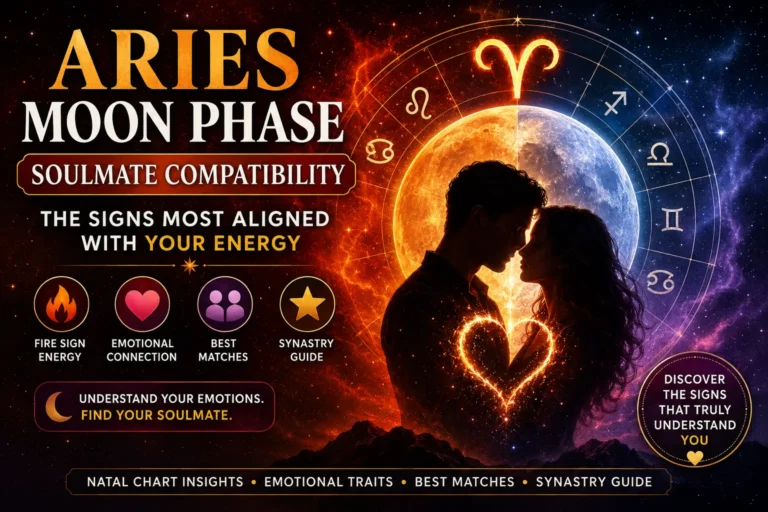
Separate from the viral phase-matching test, your natal Moon sign (not phase) says a lot about what you actually need from a partner day to day. Someone with Moon in Cancer, for example, tends to need consistent emotional reassurance — without it, they tend to withdraw. Someone with Moon in Aries tends to want variety and spontaneity to keep a relationship feeling alive.
Understanding this doesn’t require buying into every astrological claim — it just means using the framework as a lens for self-awareness and better conversations about emotional needs.
Where the Idea of a “Soulmate” Actually Comes From
The concept long predates social media. In Jewish tradition, the idea of zivug rishon refers to a first soulmate said to be destined before birth, while a “second soulmate” reflects a bond built through personal growth and lived compatibility over time.
The Oxford English Dictionary defines a soulmate more simply — someone you share deep understanding with, ideally suited as a partner or closest friend, through a bond that goes beyond surface attraction. Whatever the source, the underlying desire the moon phase trend taps into is universal: wanting a partner whose emotional rhythms genuinely match your own.
FAQs
What is a moon phase soulmate? Someone whose birth moon phase, when paired with yours, appears to visually complete a full moon — symbolizing two complementary halves coming together.
Can this test apply to friendships or family relationships? Yes. While it’s mostly used for romantic pairings, people apply the same comparison playfully to friends and family members too.
Does the moon phase soulmate test actually work? It works well as a lighthearted, reflective trend. There’s no scientific evidence that it predicts real compatibility.
What if my moon phase doesn’t match my partner’s? It doesn’t mean much on its own. Countless strong relationships exist with zero lunar alignment involved.
What are “twin flames” in this context? A twin flame is typically described as an intense, mirror-like connection. Within this trend, people born under eclipses are sometimes associated with that more chaotic, magnetic dynamic.
Is this trend scientifically accurate? No. There’s no established link between birth moon phase and human relationships or emotional outcomes.
How do I check my own moon phase match? Look up both birth dates in a lunar calendar or moon phase calculator, identify each person’s phase, and see whether the two visually combine into a full circle.