
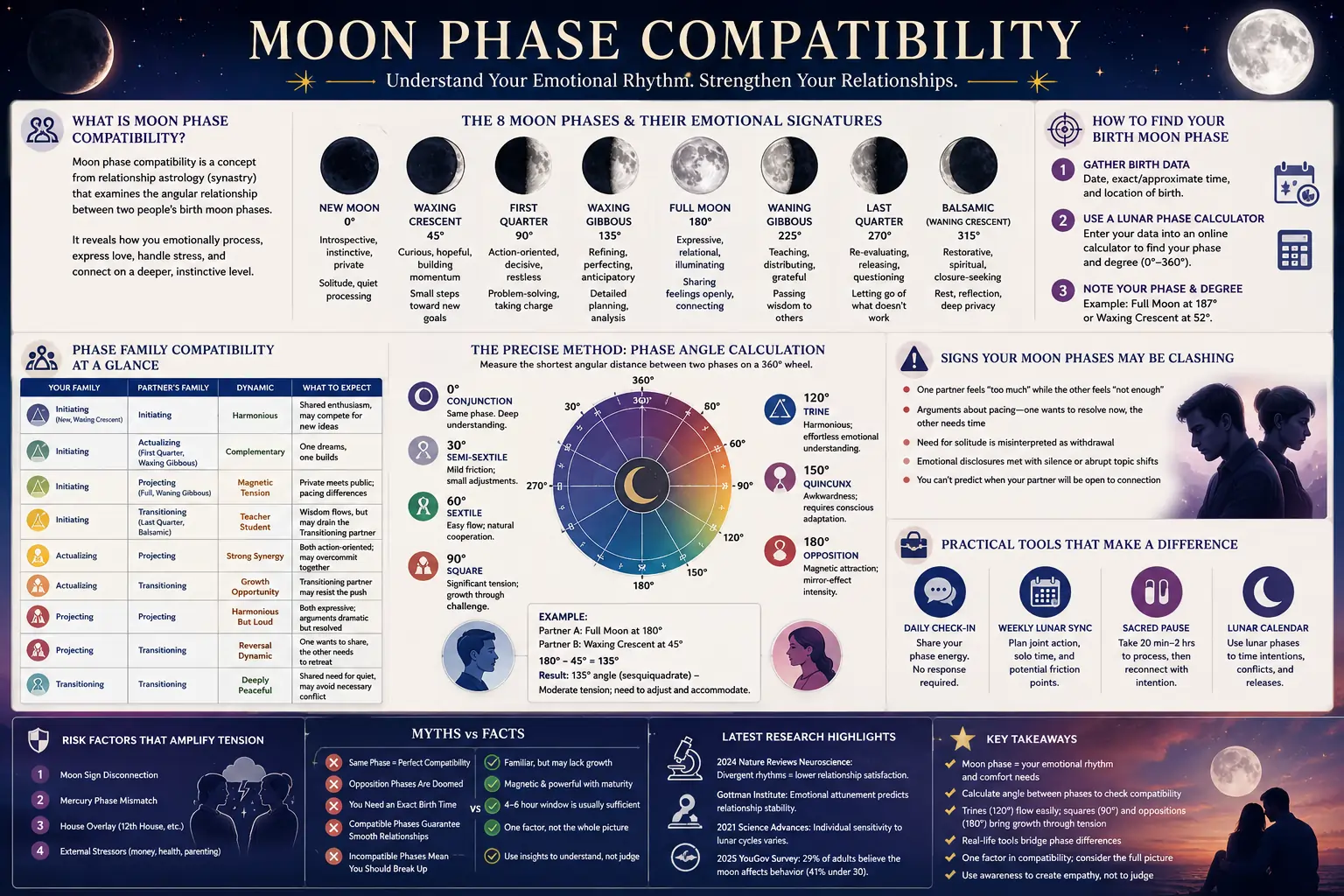
Moon phase compatibility is a concept from relationship astrology (synastry) that examines the angular relationship between two people’s birth moon phases.
Unlike sun sign compatibility which looks at outward personality moon phase compatibility focuses on your inner emotional world. It addresses questions like:
- Do you process feelings the same way?
- Do you need the same amount of alone time?
- Do you express love similarly under stress?
The moon completes a full cycle every 29.5 days, moving through eight distinct phases. The phase you were born under influences your emotional temperament. Two phases can be mathematically compared by calculating the degrees between them on a 360-degree wheel.
Table 1: The Eight Moon Phases and Their Emotional Signatures
| Moon Phase | Degrees from Sun | Emotional Style | Comfort-Seeking Behavior |
|---|---|---|---|
| New Moon | 0° | Introspective, instinctive, private | Solitude, quiet processing |
| Waxing Crescent | 45° | Curious, hopeful, building momentum | Small steps toward new goals |
| First Quarter | 90° | Action-oriented, decisive, restless | Problem-solving, taking charge |
| Waxing Gibbous | 135° | Refining, perfecting, anticipatory | Detailed planning, analysis |
| Full Moon | 180° | Expressive, relational, illuminating | Sharing feelings openly, connecting |
| Waning Gibbous | 225° | Teaching, distributing, grateful | Passing wisdom to others |
| Last Quarter | 270° | Re-evaluating, releasing, questioning | Letting go of what doesn’t work |
| Balsamic (Waning Crescent) | 315° | Restorative, spiritual, closure-seeking | Rest, reflection, deep privacy |
Why Your Moon Phase Matters in Relationships
Your moon phase influences something deeper than taste in music or weekend plans. It affects emotional pacing.
Some people wake up ready to process a conflict immediately (First Quarter types). Others need 24 hours of silence before they can articulate what they feel (Balsamic types). Neither approach is wrong. But when these rhythms don’t align, couples often misinterpret the difference as rejection or coldness.
Dr. John Gottman’s research on emotional bids—small requests for connection—shows that partners who respond to each other’s bids 86% of the time stay together. Partners who respond only 33% of the time separate. Moon phase awareness helps you recognize bids that might otherwise go unseen.
Statistic: A 2023 study published in Chronobiology International found that couples with mismatched chronotypes (morning larks paired with night owls) reported 22% more conflict than chronotype-matched couples. The researchers concluded that “temporal misalignment” creates recurring friction around daily routines. The moon phase model addresses a similar dynamic in the emotional realm.
How to Find Your Birth Moon Phase
Before checking compatibility, you need to know both partners’ moon phases. Here’s the step-by-step process.
Step 1: Gather Birth Data
You need three pieces of information for each person:
- Date of birth (month, day, year)
- Exact or approximate time of birth (within a few hours is usually sufficient for phase work, since the moon moves approximately 0.5° per hour)
- Location of birth (city and country)
Step 2: Use a Lunar Phase Calculator
The simplest method: enter birth data into an online lunar phase calculator. These tools instantly determine your phase and its degree position from 0° to 360°.
If you prefer manual calculation, you can use an ephemeris (a table of planetary positions), but the calculator method is accurate enough for compatibility work.
Step 3: Note the Phase and Degree
Record results like this:
- Partner A: Full Moon at 187° (or simply “Full Moon”)
- Partner B: Waxing Crescent at 52° (or simply “Waxing Crescent”)
You now have the raw data for your compatibility check.
How to Check Compatibility: The Phase Angle Method
This is the core technique. You’re measuring the shortest angular distance between two points on a 360-degree circle.
The Quick Method: Phase Family Grouping
For an instant scan, use the phase family system. Moon phases group naturally into four families based on their position in the lunation cycle.
Table 2: Phase Family Compatibility at a Glance
| Your Phase Family | Partner’s Phase Family | Dynamic | What to Expect |
|---|---|---|---|
| Initiating (New Moon, Waxing Crescent) | Initiating | Harmonious | Shared enthusiasm, but may compete for the “new idea” spotlight |
| Initiating | Actualizing (First Quarter, Waxing Gibbous) | Complementary | One dreams, one builds—a productive match |
| Initiating | Projecting (Full Moon, Waning Gibbous) | Magnetic tension | Private meets public; pacing differences emerge |
| Initiating | Transitioning (Last Quarter, Balsamic) | Teacher-student | Wisdom can flow, but the Transitioning partner may feel drained |
| Actualizing | Projecting | Strong synergy | Both action-oriented; may overcommit together |
| Actualizing | Transitioning | Growth opportunity | The Transitioning partner may resist the Actualizing partner’s push |
| Projecting | Projecting | Harmonious but loud | Both expressive; arguments may be dramatic but resolved quickly |
| Projecting | Transitioning | Reversal dynamic | One wants to share, the other needs to retreat |
| Transitioning | Transitioning | Deeply peaceful | Shared need for quiet, but may avoid necessary conflict |
The Precise Method: Phase Angle Calculation
For a more nuanced reading, calculate the exact angle between the two phases.
Formula:
- Convert each phase to its degree position (see Table 1)
- Subtract the smaller number from the larger number
- If the result exceeds 180°, subtract it from 360° (we always take the shortest arc)
Example Calculation:
- Partner A: Full Moon at 180°
- Partner B: Waxing Crescent at 45°
- Difference: 180° – 45° = 135°
Result: A 135° angle (sesquiquadrate). This indicates moderate tension—a need to adjust and accommodate.
What Different Angles Mean:
| Angle | Name | Emotional Dynamic |
|---|---|---|
| 0° | Conjunction | Same phase. Deep understanding, but possible echo chamber |
| 30° | Semi-sextile | Mild friction; small adjustments needed |
| 60° | Sextile | Easy flow; natural cooperation |
| 90° | Square | Significant tension; growth through challenge |
| 120° | Trine | Harmonious; effortless emotional understanding |
| 150° | Quincunx | Awkwardness; requires conscious adaptation |
| 180° | Opposition | Magnetic attraction; mirror-effect intensity |
Signs Your Moon Phases May Be Clashing
How do you know if phase incompatibility is affecting your relationship? These patterns often surface when moon phases are in hard aspect (square or opposition).
Common Emotional Signs:
- One partner consistently feels “too much” while the other feels “not enough”
- Arguments about pacing—one wants to resolve now, the other needs time
- One partner’s need for solitude is misinterpreted as withdrawal or punishment
- Emotional disclosures are met with silence or an abrupt shift to problem-solving
- You can’t predict when your partner will be open to connection
Real-Life Example:
Maya, a Full Moon type, would come home from work and immediately share every frustration from her day. Her partner, David (a Balsamic type), would sit silently, offering no response. Maya interpreted his quiet as indifference. David experienced her verbal outpouring as overwhelming.
When they learned their moon phases formed a square, the dynamic made sense. Maya processed externally; David needed internal reflection. They created a 20-minute buffer after work—Maya journaled while David decompressed—before attempting connection. Their conflict frequency dropped noticeably.
Risk Factors That Amplify Tension
Phase incompatibility doesn’t exist in isolation. Other factors can intensify or soften the dynamic.
1. Moon Sign Disconnection
Your moon phase describes your emotional rhythm. Your moon sign describes your emotional flavor. A difficult phase angle combined with incompatible moon signs (for example, an emotionally reserved Capricorn moon paired with a needy Cancer moon) can compound friction.
2. Mercury Phase Mismatch
Mercury governs communication style. If both your Mercury and Moon phases are in tension, misunderstandings multiply. Checking Mercury phase compatibility adds a useful layer.
3. House Overlay
In synastry, one person’s moon can fall into the other person’s 12th House (the house of isolation and subconscious). Even a harmonious phase angle can feel distant if the moon placement triggers hidden fears.
4. External Stressors
Phase differences feel manageable during calm periods. Under financial strain, health crises, or parenting stress, the tension amplifies. Awareness of this pattern helps couples prepare for difficult seasons.
Statistic: The American Psychological Association’s 2025 Stress in America survey found that 67% of couples report increased conflict during periods of external stress, regardless of baseline compatibility.
Working With Challenging Phase Combinations
A difficult phase angle is not a relationship death sentence. It’s a roadmap for where growth work lives.
Expert Tip #1: Name the Pattern, Not the Person
Instead of saying “You’re so distant,” try: “I think our phases are creating a silence gap. My Full Moon wants to talk. What does your Balsamic Moon need right now?”
This externalizes the issue, reducing blame. Dr. Maya Chen, LMFT, explains: “Frameworks that externalize conflict—whether it’s astrology, love languages, or attachment styles—give couples a shared vocabulary. The problem becomes ‘the square angle dynamic,’ not ‘you.'”
Expert Tip #2: Create a Phase-Aware Communication Protocol
Sit down together and map your ideal communication timing:
- Full Moon partner: Needs to express within 1-2 hours of an emotional event
- Balsamic partner: Needs 24 hours of processing time before discussing
Agreement: The Full Moon partner journals or voice-notes immediately. The Balsamic partner commits to revisiting the topic within 24 hours—not avoiding it.
Expert Tip #3: Use the Lunar Cycle as a Relationship Calendar
Track the current moon phase. Certain phases naturally support certain activities:
- New Moon: Set relationship intentions together
- First Quarter: Address one actionable conflict
- Full Moon: Share appreciations and emotional check-ins
- Last Quarter: Release grudges or outdated patterns
This rhythm provides structure that accommodates both fast and slow processors.
Table 3: When to Seek Additional Support
| Pattern | What It Might Indicate | Recommended Action |
|---|---|---|
| Arguments repeat with no resolution despite phase awareness | Deeper communication skill deficit | Couples counseling (Gottman Method or EFT) |
| One partner uses “my moon phase” to dismiss the other’s needs | Misuse of the framework as avoidance | Individual therapy to address emotional unavailability |
| Phase differences are cited to justify stonewalling or contempt | Relationship distress beyond astrological patterns | Seek a licensed therapist immediately |
| You feel persistently unheard or disrespected | Potential emotional safety issue | Individual counseling and relationship evaluation |
Prevention: Building Phase-Aware Habits
The best time to address phase differences is before conflict erupts.
Daily Check-In (2 Minutes)
Each partner answers: “What phase energy am I bringing today?” Possible answers:
- “I’m in a Crescent mood—excited but distracted.”
- “I’m feeling very Last Quarter—questioning everything.”
- “Full Moon energy—I need connection tonight.”
No response required from the other partner. This is information-sharing, not a demand.
Weekly Lunar Sync
Every Sunday, look at the upcoming week’s moon phases. Identify:
- One day for joint action (waxing phases support this)
- One day for individual processing (waning phases support this)
- One potential friction point (a hard-aspect transit day)
The “Sacred Pause” Rule
When an argument escalates, either partner can call a Sacred Pause. This isn’t stonewalling—it’s a structured break with a clear reconnection time.
- Pause duration: 20 minutes to 2 hours, agreed in advance
- During pause: No texting about the conflict. Individual processing (walk, journal, breathe).
- After pause: The partner who called the pause initiates the reconnection.
This accommodates the Balsamic need for space without triggering the Full Moon’s fear of abandonment.
Lifestyle Tips for Phase-Mismatched Couples
Sleep Considerations
Research on lunar cycles and sleep quality provides an interesting parallel. A 2013 study in Current Biology found that around the full moon, participants took 5 minutes longer to fall asleep and experienced 30% less deep sleep. If one partner is a Full Moon type (high lunar sensitivity) and the other is a New Moon type (low lunar sensitivity), their sleep experiences may differ measurably.
Practical Tip: If the Full Moon partner sleeps poorly during the actual full moon, plan for a quieter next day. The New Moon partner can offer support by handling morning responsibilities.
Social Energy Management
Full Moon and Waxing Gibbous types tend to draw energy from social interaction. Balsamic and New Moon types recharge in solitude.
Agreement: Before social events, negotiate duration. “I’ll stay two hours, then I need to leave.” The withdrawing partner takes their own transportation home if needed. No guilt, no blame.
Physical Activity as Emotional Processing
Expert Tip #4: Match Exercise to Phase Needs
Exercise can serve as emotional regulation. Align physical activity with your combined needs:
| Phase Pairing | Recommended Shared Activity | Solo Activity |
|---|---|---|
| Both Waxing | Partner HIIT, hiking, competitive sports | Waxing partner adds extra cardio |
| Both Waning | Partner yoga, nature walks, swimming | Waning partner adds meditation |
| Mixed (Waxing + Waning) | One shared walk daily | Waxing partner exercises vigorously; Waning partner does restorative movement |
Common Mistakes When Checking Moon Phase Compatibility
Many people misinterpret their results. Avoid these errors.
Mistake 1: Treating a Challenging Angle as a Verdict
A square (90°) or opposition (180°) doesn’t mean failure. Many thriving long-term relationships feature hard aspects. These angles create dynamism, which can translate to passion and growth when handled consciously.
Mistake 2: Ignoring the Full Chart
Moon phase is one factor. The entire synastry chart—including Sun, Venus, Mars, and Saturn contacts—provides the complete picture. Don’t make relationship decisions based solely on moon phase.
Mistake 3: Using Approximate Birth Times
The moon moves roughly 12° per day. If you’re off by 12+ hours on birth time, you might identify the wrong phase entirely. Always confirm with birth certificates or parents when possible.
Mistake 4: Comparing Only the Phase Name
“Both of us are Full Moon, so we’re perfect!” Not necessarily. Same-phase pairings can create emotional echo chambers where neither partner introduces a different rhythm. The relationship may lack the creative tension that spurs growth.
Mistake 5: Forgetting That People Evolve
Your moon phase describes a baseline, not a fixed destiny. Therapy, life experience, and conscious personal work all shape emotional expression over time.
Myths vs Facts
Myth 1: Same Phase = Perfect Compatibility
Fact: Same-phase relationships feel instantly familiar, which is comforting. However, they can stagnate. Without contrasting rhythms, couples may reinforce each other’s blind spots. A Full Moon-Full Moon pair, for example, may escalate arguments because neither partner naturally de-escalates.
Myth 2: Opposition Phases Are Doomed
Fact: The 180° opposition creates magnetic attraction and a “mirror effect.” You see yourself in the other person—both the good and the uncomfortable. Many power couples have opposition moons. The intensity requires maturity, not avoidance.
Myth 3: You Need an Exact Birth Time
Fact: For moon phase work, a window of 4-6 hours is usually sufficient. The moon stays in one phase for approximately 3.5 days. Unless you’re born directly on a phase boundary, approximate times work.
Myth 4: Compatible Phases Guarantee a Smooth Relationship
Fact: Harmonious phases (trines and sextiles) reduce emotional friction, but they can’t prevent conflict around values, life goals, or attachment wounds. Phase compatibility is one tool, not the whole toolkit.
Myth 5: Incompatible Phases Mean You Should Break Up
Fact: No single astrological factor dictates relationship success. The point of checking compatibility is understanding—not judging. Many couples report that working through phase differences deepened their connection more than effortless compatibility ever could.
Latest Research: The Science Adjacent to Moon Phase Compatibility
Moon phase compatibility itself hasn’t been studied in clinical settings. However, related research provides interesting parallels.
Chronobiology and Relationship Satisfaction
A 2024 review in Nature Reviews Neuroscience examined circadian rhythm alignment in cohabiting couples. Key finding: “Partners with divergent circadian phenotypes report lower relationship satisfaction, mediated by reduced shared wake-time and diminished emotional synchrony.” This secular research supports the general principle that temporal rhythm mismatches affect relationships—parallel to the moon phase concept.
Emotional Synchrony Research
The Gottman Institute’s longitudinal studies on couples identify “emotional attunement” as a key predictor of relationship stability. Attunement means recognizing and responding to a partner’s emotional state. Moon phase awareness can serve as a practical tool for improving attunement, particularly for couples who experience emotional pacing differences.
The Full Moon and Human Behavior
A 2021 systematic review in Science Advances analyzed 17 lunar-effect studies. Results were mixed: some found small but statistically significant correlations between lunar phase and sleep quality, while others found none. The authors concluded that individual sensitivity to lunar cycles likely varies—a finding that loosely mirrors the astrological concept that some people are more “lunar” than others.
Statistic: A 2025 YouGov survey found that 29% of American adults believe the moon affects human behavior. Among respondents under 30, that figure rose to 41%.
Summary Box
What We Covered:
- Moon phase compatibility examines the emotional rhythm match between two people
- Finding your phase requires birth date, approximate time, and location
- Compatibility is calculated by measuring the angular distance between two phases on a 360° wheel
- Same-family phases generally harmonize; cross-family phases require more conscious adaptation
- Challenging angles are not failures—they’re growth opportunities
- Practical tools include daily check-ins, the Sacred Pause, and lunar cycle planning
- Related scientific research on chronobiology and emotional attunement supports the general framework
The single most important point: Compatibility awareness serves the relationship—not the other way around. Use this information to understand, not to judge.
Key Takeaways
- Your moon phase at birth reflects your emotional processing style and comfort needs
- To check compatibility, find both partners’ phases and calculate the angle between them
- A 120° trine feels harmonious; 90° squares and 180° oppositions bring growth through tension
- Real-life adjustments—timed communication, Sacred Pauses, and lunar planning—can bridge phase differences
- Moon phase is one factor in relationship compatibility; always consider the full picture
- Consult a licensed therapist for persistent relationship distress, regardless of astrological patterns
- Transparency about this framework’s spiritual origins builds more trust than pretending it’s science
Frequently Asked Questions
1. Can incompatible moon phases work long-term?
Yes. Many couples with square or opposition phases build lasting, fulfilling relationships. The key is awareness: understanding that your partner operates on a different emotional clock, not that they’re intentionally distant or overwhelming.
2. Is a Full Moon compatible with a New Moon?
This pair forms an opposition (180°), which creates magnetic attraction. The Full Moon partner processes outwardly and expressively; the New Moon partner turns inward. With communication and respect for different pacing, this pairing can be deeply complementary.
3. What’s the most compatible moon phase match?
Phases 120° apart (trine) generally experience the easiest flow. For example, a Waxing Crescent and Waxing Gibbous are in the same waxing family but at different stages, creating a natural mentor-student harmony. However, “easiest” doesn’t always mean “most fulfilling.”
4. How do I ask someone about their moon phase without seeming weird?
Frame it as curiosity rather than a test. Try: “I’ve been learning about birth charts recently—it’s surprisingly interesting. Do you know what moon phase you were born under? I can show you how to check if you want.” Keep it light and optional.
5. Does the current moon phase affect compatibility?
Yes, transiting moon phases can highlight or soften your natural dynamic. A couple with a square phase angle might feel extra tension during actual square-moon transits. Tracking the current lunar cycle adds a practical layer to compatibility awareness.
6. Should I end a relationship over incompatible moon phases?
No. No single astrological factor should determine a major life decision. Use moon phase insight as one tool among many—alongside communication skills, shared values, mutual respect, and professional counseling when needed.
7. What if I don’t know my exact birth time?
A 4-6 hour window is usually sufficient for moon phase identification. The moon stays in one phase for roughly 3.5 days. Unless you’re born directly on a phase boundary, approximate times work for compatibility checking.
8. Can moon phase compatibility apply to friendships and work relationships?
Absolutely. Any relationship involving emotional exchange can benefit from phase awareness. In workplaces, understanding that a Balsamic-phase colleague needs quiet processing time can reduce friction and improve collaboration.
9. How is moon phase compatibility different from moon sign compatibility?
Moon phase describes the rhythm of emotional expression (fast vs. slow, inward vs. outward). Moon sign describes the flavor (Cancer moon is nurturing; Aquarius moon is detached). Both matter, but phase governs pacing, which is often the source of daily friction.
10. What if our phases are compatible but we still have problems?
Phase compatibility reduces emotional rhythm friction, but it can’t solve all relationship challenges. Issues around trust, values, communication skills, or unresolved trauma require their own attention—possibly with a therapist’s support.
11. Can my moon phase change with personal growth?
Your birth moon phase is fixed. However, how you express that phase can evolve. A Balsamic type can learn to articulate needs more quickly. A Full Moon type can develop comfort with solitude. Personal growth changes expression, not the underlying blueprint.
12. Is there any scientific proof for moon phase compatibility?
Direct clinical studies on moon phase compatibility don’t exist. However, related research on chronobiology, emotional attunement, and circadian rhythm alignment provides secular support for the general principle that timing and rhythm differences affect relationships.
13. What if my partner doesn’t believe in astrology?
You can still use the framework privately. Notice their emotional patterns, respect their timing preferences, and adjust your approach accordingly—without ever mentioning “moon phases.” The practical adjustments work whether or not your partner believes in the theory behind them.
14. How often should we check our phase compatibility?
Your natal phases don’t change, so you only need to calculate once. However, tracking current lunar transits against your natal phases can provide ongoing insight into when your dynamic feels more or less tense.
15. Where can I learn more about moon phase work?
Dane Rudhyar’s The Lunation Cycle is the foundational text on moon phase personality. For relationship applications, many astrological organizations (ISAR, NCGR) offer workshops and webinars on synastry techniques.
Conclusion
Checking your moon phase compatibility takes about ten minutes. Understanding what it means takes longer and practicing what you learn takes a lifetime.
The goal isn’t finding a partner with a “perfect” phase match. It’s recognizing that your partner’s emotional rhythm isn’t wrong it’s different. A square angle isn’t a curse. An opposition isn’t fate. They’re information.
When you know your partner’s phase, you gain a lens for interpreting behavior that once confused or hurt you. The silence after an argument might be processing, not punishment. The immediate emotional flood might be connection-seeking, not drama.
Use this framework as a tool for empathy. Combine it with good communication skills, mutual respect, and when needed professional support. Astrology doesn’t replace relationship work. It just gives you a better map.